
This guide covers the concrete revenue mechanisms: where the money comes from, how the numbers stack up across different venue types, and what operational factors determine whether a simulator reaches its revenue potential or falls short of it.
The Revenue Mechanisms: More Than Just Session Fees
The most visible revenue from an interactive soccer simulator is the simplest one: charging guests per session. A typical pricing model of $5 to $15 for 10 to 15 minutes of play, cycling through four to six groups per peak hour, generates $30 to $90 in direct session revenue per hour from a single unit. Over a standard 12-hour operating day at 50% utilization, that's roughly $180 to $540 in daily direct play revenue — before any of the indirect effects that arguably matter more to total financial performance.
Food and beverage uplift is consistently the largest indirect revenue benefit, and one that operators frequently undercount when building the investment case. Guests who are actively engaged — playing, watching friends play, waiting for their turn — order more food and drink than guests who are passively sitting. The competitive atmosphere an interactive soccer simulator creates is particularly effective: groups lingering for rematches or waiting to beat a leaderboard score extend visit duration by 45 to 90 minutes on average. In venues where F&B margins run 60 to 80%, the value of that extended dwell time can exceed the direct session revenue itself.
Group and party bookings turn the simulator from a drop-in attraction into a pre-sold, predictable revenue line. A 90-minute exclusive booking slot for a birthday party, corporate team event, or group celebration bundled with F&B packages typically commands $100 to $350 per booking. These fill the simulator schedule in advance and bring groups who spend consistently across the visit.
Tournament and league events fill off-peak slots that would otherwise generate nothing. Weekly competitions with entry fees or prize incentives create a regular return visit habit among your most engaged customers. Venues with interactive soccer attractions can also engage fans before, during, and after football broadcasts — turning fan zones into interactive spaces that build excitement pre-game and during half-time breaks, and creating a long-term attraction monetizable year-round.
Why Dwell Time Is the Real Revenue Driver
The revenue logic of an interactive soccer simulator becomes clearer when you focus on dwell time rather than session fees alone. Indoor soccer simulation interactive entertainment equipment delivers high dwell time alongside diversified revenue channels — per-session sales, parties, leagues, and F&B uplift — making payback periods that commonly fall within 12 to 36 months depending on location and operational execution.
The dwell time effect works through a straightforward mechanism. A group that arrives for dinner and encounters a soccer simulator stays for dinner plus simulator sessions plus the drinks ordered while waiting for their turn. The total spend per table or per group increases without any additional marketing cost. The simulator effectively does the upselling by giving guests a reason to stay longer.
This is why the hospitality industry — bars, restaurants, and hotel lounges particularly — has been the fastest adopter of interactive soccer simulators as entertainment additions. Sports simulators offer longer dwell time and high repeat play rates compared to traditional arcade machines. In a bar context where the simulator occupies roughly 40 square meters and the hourly beverage margin from an engaged group significantly exceeds the direct play revenue, the financial case for the floor space is easily made.
Operational Variables That Determine Revenue Performance
The revenue potential of an interactive soccer simulator isn't fixed — it's a range, and where you land within that range depends primarily on operational decisions.
- Automation level A simulator requiring staff to retrieve balls or reset between sessions can't cycle through four to six groups per hour. Every manual step reduces the number of paying sessions in a peak evening. Systems with full-cycle automated ball launch and return remove this constraint entirely.
- Game variety A single game mode creates a finite experience that regular visitors exhaust within a few sessions. Systems with eight or more distinct modes give returning guests new targets on each visit, sustaining the repeat visit frequency that drives monthly revenue, not just opening-month revenue.
- Pricing and booking structure Venues that only sell walk-in session time leave significant revenue on the table compared to those that also offer pre-booked party packages, group event slots, and weekly tournament entries. Dynamic pricing — higher rates during peak hours, lower off-peak — is standard practice among the best-performing simulator venues.
- Visibility and placement An interactive soccer simulator visible from the entrance or positioned along a main circulation route generates more revenue than one tucked into a back corner. The social spectacle it creates — watching someone attempt a penalty kick, hearing the crowd reaction — is free marketing that converts passersby into paying players.
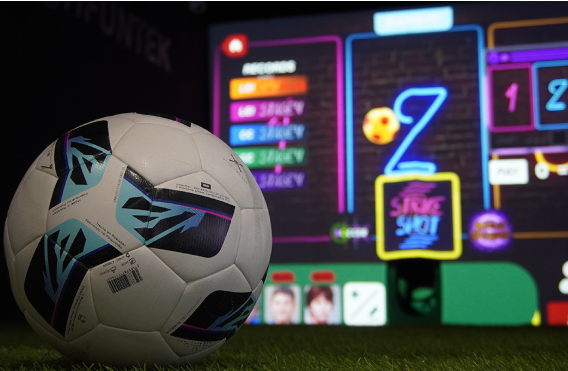
How Chfuntek's Socabot Is Engineered Around These Revenue Drivers
For venue operators who want an interactive soccer simulator specifically built to maximize the revenue mechanisms described above, Chfuntek's Socabot Interactive Soccer Simulator addresses each of them directly.
The patented automatic ball launcher and full-cycle ball return eliminate manual intervention entirely, enabling the uninterrupted session throughput that peak-hour revenue requires. The game library's eight distinct modes — Tic-Tac-Toe Challenge, Moving Target, Goalkeeper Duel, Free Kick Challenge, Time Pressure, Speed Run, Engine Kick, and High Score Attack — sustain repeat visit interest across the full year rather than peaking in the first month. New modes are added continuously, which prevents the engagement plateau that limits the revenue lifespan of less regularly updated systems.
The entertainment version fits a 4m × 9m footprint with a 3.5m suspended height — compatible with most commercial venue floor plans without major structural work. The result: higher customer satisfaction, longer dwell times, and increased food and beverage sales — outcomes that translate directly into the revenue lift that makes the investment case. For operators running training facilities or sports academies, the professional training version covers a 15m × 15m configuration with performance data and coaching feedback as the primary output.
Want to Model the Revenue Impact for Your Venue?
Get a tailored consultation on how Socabot's revenue profile fits your specific venue type and footprint.
Talk to the Chfuntek TeamFrequently Asked Questions
How much revenue can an interactive soccer simulator generate?
Direct session revenue at 50% utilization across a 12-hour operating day typically runs $180 to $540 per day. Add F&B uplift from extended dwell time, party booking revenue, and tournament entry fees, and total venue revenue contribution can significantly exceed the direct session income alone.
How long before an interactive soccer simulator pays back its investment?
Payback periods across indoor soccer simulation installations commonly fall within 12 to 36 months depending on location, foot traffic, pricing strategy, and operational execution. Higher-traffic venues with active group booking programs tend toward the shorter end of that range.
Does an interactive soccer simulator require dedicated staff to operate?
Systems with automated ball launch and return run between sessions without staff involvement. This is one of the most commercially important features to evaluate — peak-hour revenue depends on continuous operation, which only fully automated systems can sustain without creating staffing bottlenecks.
What types of venues see the best ROI from an interactive soccer simulator?
Bars, family entertainment centers, hotels, and restaurants with significant F&B revenue see the strongest combined ROI because the dwell time effect compounds the direct session revenue. Standalone sports venues and football clubs benefit from the training version's performance data rather than entertainment-focused revenue streams.
What game modes drive the highest repeat visit rates?
Leaderboard-based modes — particularly personal-best formats like High Score Attack — consistently drive the strongest repeat visit motivation. Head-to-head competitive formats like Goalkeeper Duel and Tic-Tac-Toe Challenge generate natural rematch behavior among friend groups.
Final Thoughts
An interactive soccer simulator boosts venue revenue through four compounding mechanisms: direct session fees, extended dwell time driving F&B uplift, pre-sold group event packages, and the off-peak fill that tournament and league structures provide. The magnitude of each depends on operational decisions — automation level, game variety, pricing structure, and physical placement — more than on the hardware specification alone.
For operators who want both the revenue case and the operational capability to realize it, a system that runs autonomously, maintains a deep game library, and is backed by genuine installation and after-sales support is what actually delivers. The simulator is the starting point; the operational execution is what determines where in the revenue range you actually land.
Want to understand exactly how Socabot's revenue profile would fit your specific venue type and footprint? Contact the Chfuntek team for a tailored consultation.


