
This article compares the two formats across the dimensions that matter for players, club managers, hotel entertainment directors, FEC operators, and sports center managers deciding how to allocate floor space, court time, and training budgets in 2026.
What an Indoor Tennis Simulator Delivers That Traditional Training Cannot
On-Demand Availability Without Scheduling Dependency
The most immediate practical advantage of an indoor tennis simulator over traditional court training is availability. A player who wants to work on backhand accuracy at 7am, 11pm, or during a thunderstorm that closes the outdoor courts faces no barrier with a simulator — the system is available whenever the facility is open, requires no booking, and doesn't depend on a coach's schedule or a hitting partner's availability. For club managers and venue operators, this translates directly into utilization: a simulator fills the gaps in facility usage that court scheduling leaves behind — early mornings, late evenings, off-peak weekday periods, and weather-dependent downtime — generating incremental revenue without additional staffing cost.
Automatic Ball Delivery and Precise Repetition
Traditional coach-fed or machine-fed ball delivery requires either a person or a separate ball machine, and both have limitations: coach fatigue in long feeding sessions, limited trajectory variety from older ball machines, and the constant need to collect and reload balls. An indoor tennis simulator with integrated automatic ball feeding and return removes all of these constraints simultaneously. The commercial implication is throughput: a simulator that feeds, tracks impact, scores, and returns the ball autonomously supports continuous play at a pace manual feeding cannot match. For coaching sessions, this means more drills per session per player; for entertainment venues, it means more group sessions per operating hour without staff involvement between players.
Immediate Digital Feedback
Traditional tennis training provides feedback through coach observation, video review, and the physical experience of the ball's response. An indoor tennis simulator adds a third feedback channel: real-time digital scoring and visual response to every shot, immediately visible on the screen. For casual players and beginners, this digital feedback layer is particularly valuable — a first-time player who has no basis for evaluating their swing technique can immediately understand whether they hit the target, what their score was, and how it compares to their previous attempt. That accessible feedback loop is what makes a simulator commercially viable as a guest entertainment attraction in contexts where a significant portion of users have no prior tennis experience.
Weather Independence and Space Efficiency
A full regulation tennis court is 78 feet by 36 feet — 2,808 square feet. A commercial indoor tennis simulator installation fits within roughly 400 to 500 square feet. For urban venues, hotel entertainment zones, and FECs where floor space has significant cost, this space efficiency fundamentally changes what's commercially viable. An indoor tennis simulator generates revenue in 400 square feet that a regulation court would need 7 times the space to match — and does so regardless of weather, at any hour the facility is open.
What Traditional Training Offers That an Indoor Tennis Simulator Cannot
Full Court Movement and Match Conditioning
Tennis is a sport defined by movement as much as by stroke mechanics. Court coverage, split-step timing, recovery positioning, and the physical conditioning from sustained match play cannot be replicated by a simulator. A player standing in a fixed hitting position — even on a system with excellent ball delivery and tracking — is developing striking skill but not the movement patterns and aerobic capacity that on-court match play builds. For competitive players, this is the most important limitation to understand. The simulator is highly effective for repetition-based stroke development and accuracy training; it is not a substitute for on-court match play in a complete training program.
Live Opponent Adaptability
Real match play against a live opponent develops the reading and anticipation skills that a fixed delivery system cannot replicate. A simulator delivers balls at preset or programmed parameters; a real opponent generates balls based on their own shot selection, positioning, and strategy, which requires a different cognitive engagement. For competitive players, this opponent-reading dimension of tennis development requires actual match play against varied opponents — a simulator is a preparation and drilling tool, not a substitute for competitive play.
Social and Community Dimensions
Traditional court play, club membership, and structured group lessons develop social connections that contribute to long-term player retention in ways that solo simulator sessions don't. For tennis clubs and sports centers, the social dimension of the sport is part of the retention mechanism that keeps members renewing — which means a simulator should be positioned as an enhancement to the social club experience, not a replacement for it.
How to Use Both Formats Most Effectively in 2026
| Dimension | Indoor Tennis Simulator | Traditional Training |
|---|---|---|
| Availability | On-demand, any hour, weather-proof | Booking-dependent, weather-affected |
| Ball delivery | Fully automatic, no fatigue | Coach/partner required |
| Feedback | Instant digital scoring per shot | Coach observation, video review |
| Space required | ~400–500 sq ft | 2,808 sq ft (regulation) |
| Court movement | Fixed position only | Full court movement & conditioning |
| Opponent adaptability | Preset parameters | Live, unpredictable responses |
| Social / community | Solo or small group | Club community & match play culture |
For Competitive Players
The most effective integration uses the simulator for high-volume repetition in specific skill areas — accuracy, reaction time, consistency under time pressure — while preserving court time for movement training, match play, and tactical development. A player who uses 30 minutes on the simulator for focused accuracy drills before a 90-minute court session is doing something distinctly different from a player who uses the simulator as a replacement for court time. The former uses both tools for what they do best; the latter misses what court play uniquely provides.
For Tennis Clubs and Sports Centers
For clubs and sports centers, the indoor tennis simulator's strongest commercial positioning in 2026 is as a complementary off-court attraction generating revenue during off-peak hours, serving members who want additional practice outside booked court sessions, and providing an accessible entry point for non-members and beginners. It extends revenue-generating hours, serves a demographic the court schedule alone can't accommodate, and differentiates the club from facilities offering only court time.
For Hotels, FECs, and Sports Bars
For entertainment and hospitality venues, the comparison between simulator and traditional training is largely irrelevant — their audience is not primarily players in a competitive training program. The indoor tennis simulator in a hotel, FEC, or sports bar context is serving guests who want a physical, competitive, engaging activity regardless of their tennis background. The game modes, scoring, and competitive dynamics make it an entertainment attraction first and a training tool second — which is appropriate for the context and the commercial model.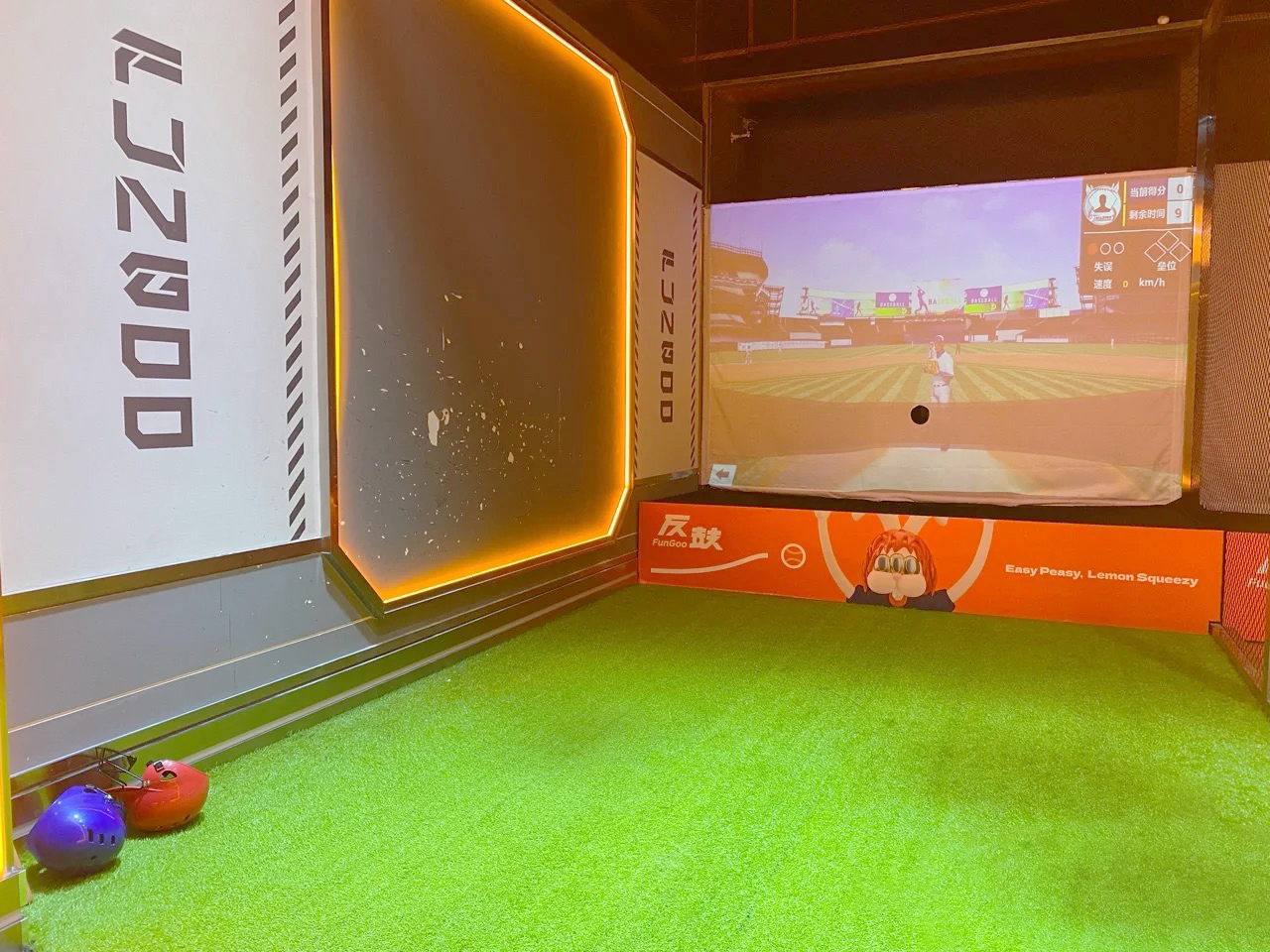
How Chfuntek's Commercial Tennis Simulator Fits Both Contexts
Chfuntek's commercial indoor tennis simulator is designed for the venue contexts described above — clubs, sports centers, hotels, FECs — rather than as a home training device. The system uses real rackets and real balls with sensor and projection technology tracking each shot autonomously, with automatic ball feeding and full-cycle ball return eliminating staff dependency between sessions.
Practice Mode — casual, low-pressure engagement for first-time and recreational players; no scoring requirement; the accessible entry point that converts hesitant guests into returning visitors.
Training Mode — structured skill development with repeatable delivery patterns aligned with coaching objectives; for members and players working on specific technical aspects of their game.
Skill Challenge Mode — competitive scored play with leaderboard mechanics; the mode that drives repeat visit motivation by giving guests a specific ranking to defend or improve.
Commercial construction — built to commercial durability specifications for sustained daily use; not adapted from a residential product.
Factory-trained installation + operator training included as standard; pre-purchase space planning consultation available to confirm the system fits your venue before any commitment is required.
Interested in Adding an Indoor Tennis Simulator to Your Venue or Program?
Contact the Chfuntek team for a configuration consultation and complete project quote — tailored to your specific venue type, available space, and commercial objectives.
Talk to the Chfuntek TeamFrequently Asked Questions
Is an indoor tennis simulator better than traditional training?
Neither is universally better — each excels at different things. An indoor tennis simulator delivers on-demand availability, high-volume stroke repetition, digital feedback, and commercial entertainment engagement. Traditional training delivers full court movement, live opponent adaptability, and match conditioning. The most effective programs for competitive players use both.
Can an indoor tennis simulator replace court practice?
For recreational and entertainment purposes, yes — a simulator provides a complete, engaging tennis experience without a court. For competitive player development, no — court movement, live opponent adaptability, and match conditioning require actual on-court play that a simulator supplements but does not replace.
What is the commercial advantage of an indoor tennis simulator over additional court construction?
An indoor tennis simulator delivers a tennis experience in approximately 400 to 500 square feet versus a regulation court's 2,808 square feet. It operates autonomously during all facility hours without additional staffing, and serves beginners and casual guests who wouldn't book a full court session but will engage with a simulator-based attraction.
How do indoor tennis simulators support tennis club member retention?
By extending available practice time beyond court booking hours, providing an accessible off-court option for beginners and casual members, and offering competitive scored formats that give regular members a new way to engage with the sport outside their standard court sessions.
What game modes does Chfuntek's commercial indoor tennis simulator include?
Three modes covering the range from beginner-accessible through competitive: Practice Mode for casual engagement without scoring pressure, Training Mode for structured skill development, and Skill Challenge Mode for competitive scored play with leaderboard mechanics.
Final Thoughts
The indoor tennis simulator vs. traditional training comparison resolves differently depending on who's asking. For a competitive player, the simulator is a powerful complementary drilling tool — not a replacement for court play and match conditioning. For a club manager or sports center director, it's a revenue-extending complementary facility. For a hotel, FEC, or sports bar operator, the comparison is largely irrelevant — the simulator is an entertainment attraction that happens to use tennis mechanics, serving a guest profile that traditional training formats don't reach at all.
Getting the positioning right for each context is what determines whether an indoor tennis simulator investment delivers on its commercial promise.
Interested in how Chfuntek's commercial indoor tennis simulator fits your specific venue or program? Contact the Chfuntek team for a configuration consultation and complete project quote.


