
Football is already something people understand and care about. An interactive football game just gives them a way to play rather than watch. That's a meaningful commercial distinction, and it's why this category has grown so consistently across hospitality, entertainment, and FEC environments over the last several years.
What Makes an Interactive Football Game "Commercial Grade"
The distinction matters more than most first-time buyers expect. A product that looks compelling in a demonstration environment may reveal serious operational shortcomings within the first month of peak-hour use.
Automated operation is the first test. An interactive football game that requires staff to retrieve balls, reset targets, or manually restart sessions between groups is not commercially viable during busy service periods. The only systems that work reliably in commercial hospitality are those that manage the complete ball cycle autonomously: launch, play, retrieve, reset, ready for the next group.
Game variety and depth is the second. A single-mode system has a predictable engagement arc — guests play it enthusiastically for the first few weeks, find the edges of the experience within a month, and the machine starts sitting idle during off-peak periods while still consuming floor space. Interactive football games that sustain commercial value need multiple distinct modes, adjustable difficulty, and ideally ongoing software updates.
Durability and service support is the third. Equipment operating in commercial hospitality needs to be built to a different standard than equipment designed for light use. Build quality, expected service intervals, parts availability, and supplier support responsiveness all belong in the evaluation before a purchase decision is made.
The Options Available to Venue Operators
Tabletop Football (Foosball)
Compact, durable, requires no power or software, works for any venue with minimal space. Its limitation is depth — there is essentially one experience available, and it doesn't evolve. For venues testing engagement with low capital risk, it remains a valid entry point. As a primary revenue-driving attraction, it falls short.
Kick-at-Target Systems
Wall-mounted or portable systems that let players kick a real ball at physical or illuminated targets. More visual spectacle than foosball, and they generate crowd-forming activity that converts passersby into players. Main limitation: most lack meaningful game structure — there's a finite novelty ceiling without competitive scoring, leaderboards, or evolving challenge formats.
Interactive Digital Football Simulators
The category that delivers the strongest sustained commercial performance. A large projection or LED screen displays a dynamic game environment; sensors or camera systems track where the ball strikes the surface; software translates that into immediate on-screen feedback — goal celebrations, accuracy scores, goalkeeper responses, competitive rankings. Multiple game modes, leaderboard mechanics, and ongoing content updates give the system genuine long-term replay value.
Professional Training Simulators
A distinct category aimed at football clubs, academies, and training centers rather than hospitality venues. These systems prioritize performance data and coaching feedback over entertainment value, and they require larger dedicated spaces and a different audience profile.
What to Evaluate Before You Buy
- Session throughput During peak hours, how many groups can the system cycle through per hour without bottlenecks? A system with a 45-second automated reset can turn over four to six groups per hour. One with a 3-minute manual reset can't keep pace on a busy evening.
- Game mode variety Eight distinct modes serve a different commercial function than two — not because guests will play all eight in one visit, but because they'll encounter something different on visit two and three, which drives repeat visit behavior.
- Space requirements Commercial entertainment-grade interactive football games require approximately 4 to 9 meters in depth with ceiling clearance of at least 3.5 meters. Confirm exact dimensions before any lease or purchase decision.
- After-sales support What is the response time for service calls? What parts are held in regional inventory? Who does the initial installation and calibration? These answers matter more to 3-year operating cost than the headline price.
Why Chfuntek's Socabot Stands Out in This Category
For venue operators specifically looking for the best interactive football game built to commercial operational standards, Chfuntek's Socabot Interactive Soccer Simulator has been designed from the ground up for exactly the venue environment described above.
The core hardware — a patented automatic ball launcher with adjustable speed and angle, combined with a full-cycle automatic ball return — eliminates manual intervention entirely. Staff don't touch the system between sessions. The machine launches, tracks, scores, and resets autonomously across back-to-back group sessions during peak hours.
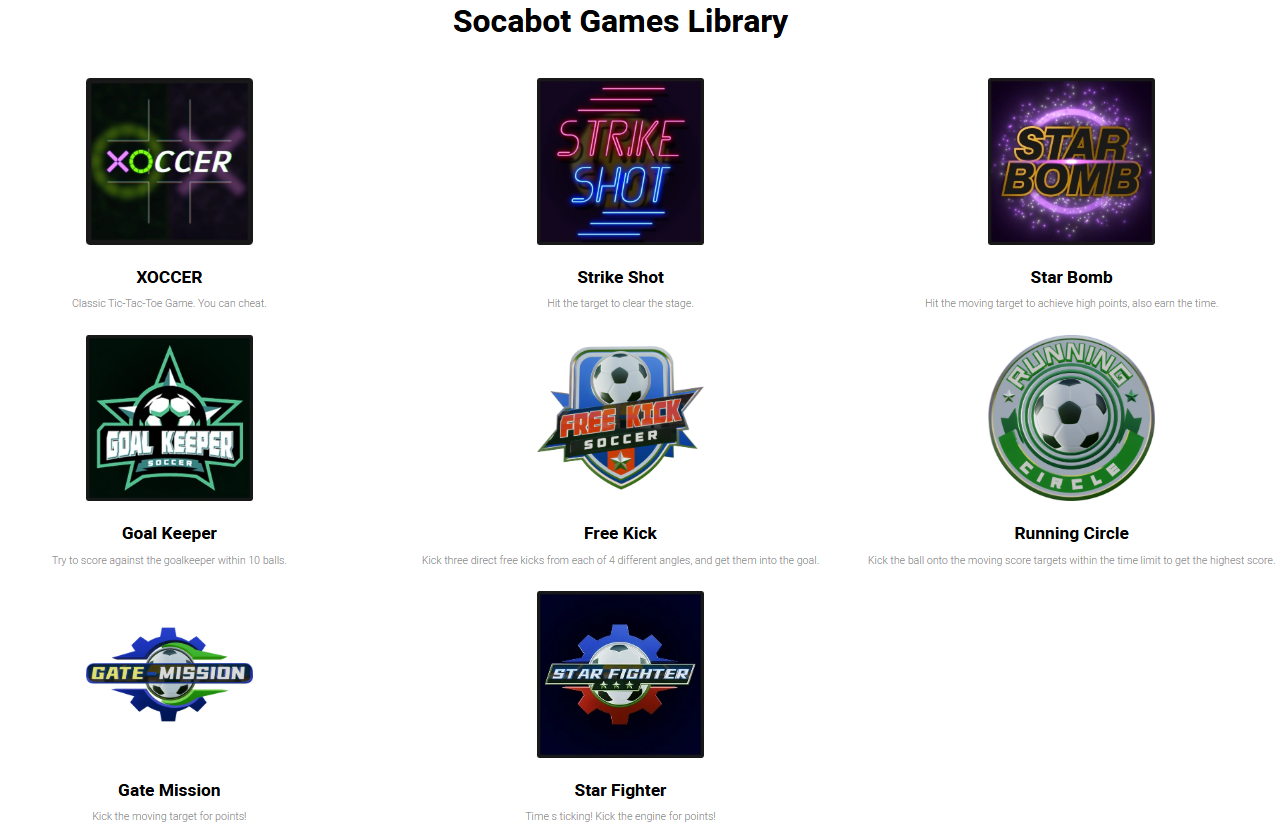
The current game library covers eight distinct modes, each designed around a different player motivation:
Tactical grid shooting, natural for group competition and rematches — spectators quickly want their own turn.
Reaction and accuracy under time pressure, popular on leaderboards and among competitive regular guests.
10 shots against an adaptive virtual goalkeeper — familiar and immediately compelling for football fans of any skill level.
Three kicks from four angles, mirrors real penalty-phase football. Deeply replayable for anyone with football knowledge.
Moving score targets within a countdown — generates audible excitement and crowd engagement around the machine.
Pure pace and accuracy combined, ideal for competitive regulars who have mastered the slower-paced modes.
Dynamic scoring mechanics that shift during play — unpredictability keeps experienced players engaged session after session.
Personal-best format that creates the strongest repeat visit motivation — players return specifically to beat their own numbers.
New games are added to the library on an ongoing basis, which prevents the engagement plateau that fixed-library systems inevitably reach within months of installation. The entertainment version fits within a 4m × 9m footprint with a 3.5m suspended height — compatible with most FEC zones, hotel lounges, sports bars, and restaurant entertainment areas. Factory-trained engineers handle on-site installation; one-on-one operator training is included as standard.
For venues that need a professional training version rather than a social entertainment setup, a 15m × 15m configuration is available for football clubs and sports centers focused on player development.
Want to See Socabot's 8 Game Modes in Action?
Get a tailored recommendation based on your venue type, floor plan, and audience goals.
Talk to the Chfuntek TeamFrequently Asked Questions
What makes an interactive football game commercially viable for a venue?
The combination of fully automated operation (no staff required between sessions), multiple game modes that sustain repeat interest across visits, and a leaderboard system that creates ongoing competitive motivation. Systems missing any of these elements tend to underperform their investment timeline.
How much space does an interactive football game need?
Commercial entertainment-grade systems typically require approximately 4m × 9m of floor space with a minimum ceiling height of 3.5m. Confirm exact specifications with the supplier before committing to a venue layout, as enclosure framing adds to the stated footprint.
Can one interactive football game serve both casual guests and serious football players?
Yes, if the system has adjustable difficulty and multiple game modes. Socabot's eight modes cover everything from first-time players enjoying basic target challenges to competitive guests chasing leaderboard rankings — all on the same installation without reconfiguration.
How does an interactive football game drive repeat visits?
Through leaderboard mechanics, personal-best scoring, and game variety. Guests who finish a session with an unbeaten score to defend or a friend's ranking to beat have already started planning their return. Eight distinct modes give returning visitors new challenges to explore rather than a repetition of the previous session.
What ongoing maintenance does a commercial interactive football game require?
Systems with automated ball launch and return minimize routine maintenance requirements significantly. For Socabot, factory engineers handle installation; operator training covers day-to-day management; and the system's commercial-grade components are designed to run sustained daily operation without frequent technical intervention.
Final Thoughts
The best interactive football game for an entertainment venue isn't the one with the most impressive demonstration — it's the one that performs consistently during a busy Friday evening six months after installation, when the novelty has worn off and the machine needs to earn its floor space on replay value and operational reliability alone.
Automated operation, game variety, and build quality are the three factors that separate equipment that sustains commercial performance from equipment that peaks in month one. For most commercial entertainment and hospitality environments, a digital interactive football game meeting those criteria — and supported by a supplier with genuine installation and after-sales capability — is one of the strongest attractions available for the footprint it occupies.
Want to see how Socabot's eight game modes and automated operation would fit your specific venue? Contact the Chfuntek team for a tailored recommendation.


