
Auto ball return sounds like a minor convenience. In practice, it's the difference between a self-sufficient attraction and one that quietly drains staff time every hour it operates. This guide breaks down what to look for in a soccer arcade game's ball return system, why it matters for commercial venues, and how the game library built around that system determines whether guests come back a second time.
Why Auto Ball Return Is the Defining Commercial Feature
A soccer arcade game without automated ball return creates a loop that looks something like this: player kicks, ball hits screen or target, ball rolls to a corner, staff or player retrieves ball, game resumes. Repeat every 30 to 90 seconds for the entire session. Across a busy evening of back-to-back groups, that manual retrieval cycle consumes significant staff time that isn't going toward service, upsells, or anything that generates revenue.
The operational math is straightforward. At average commercial staffing costs, 20 to 30 minutes of manual ball retrieval per shift translates into a real recurring labor cost most operators never explicitly calculate — it just disappears into "general upkeep." A soccer arcade game with a properly engineered automatic ball return eliminates that cost entirely.
Beyond labor, there are two other advantages. First, faster reset times between groups mean more paid sessions per operating hour — the attraction doesn't bottleneck on staff availability. Second, consistent automated resets deliver the same experience to the first group of the day and the last, rather than varying by whoever happens to be nearby when the ball stops rolling.
What a Genuine Auto Ball Return System Looks Like
Not every "automated" feature in a soccer arcade game is equal. Some systems automate only part of the cycle — the launcher delivers balls, but retrieval still requires manual intervention. Others require regular hopper refills that put staff back into the loop indirectly.
A genuine full-cycle auto ball return does three things without human input: it retrieves the ball after the kick, transports it back to the launch position, and queues it ready for the next delivery. The player's only job is to kick.
Key questions to ask before purchasing:
- Does the system retrieve balls automatically after every kick, or only after a full session ends?
- How long does a full cycle take from kick to next delivery?
- Does the ball return mechanism require regular staff calibration or adjustment during operating hours?
- What happens if a ball misses the primary return path — is there a recovery mechanism, or does it require manual intervention?
The answers to these questions tell you far more about real operational performance than any spec sheet.
Game Library: The Other Half of the Repeat Visit Equation
A soccer arcade game's ball return system determines how smoothly it runs. Its game library determines whether guests have a reason to come back. These two factors are inseparable in terms of commercial value — a smooth-running machine with a single repetitive game mode will see interest peak and decline within a few weeks.
The strongest soccer arcade games for commercial venues offer multiple distinct formats that appeal to different types of players: accuracy-based challenges for casual guests, timed pressure modes for competitive players, and goalkeeper-style games that create natural crowd dynamics when others watch.
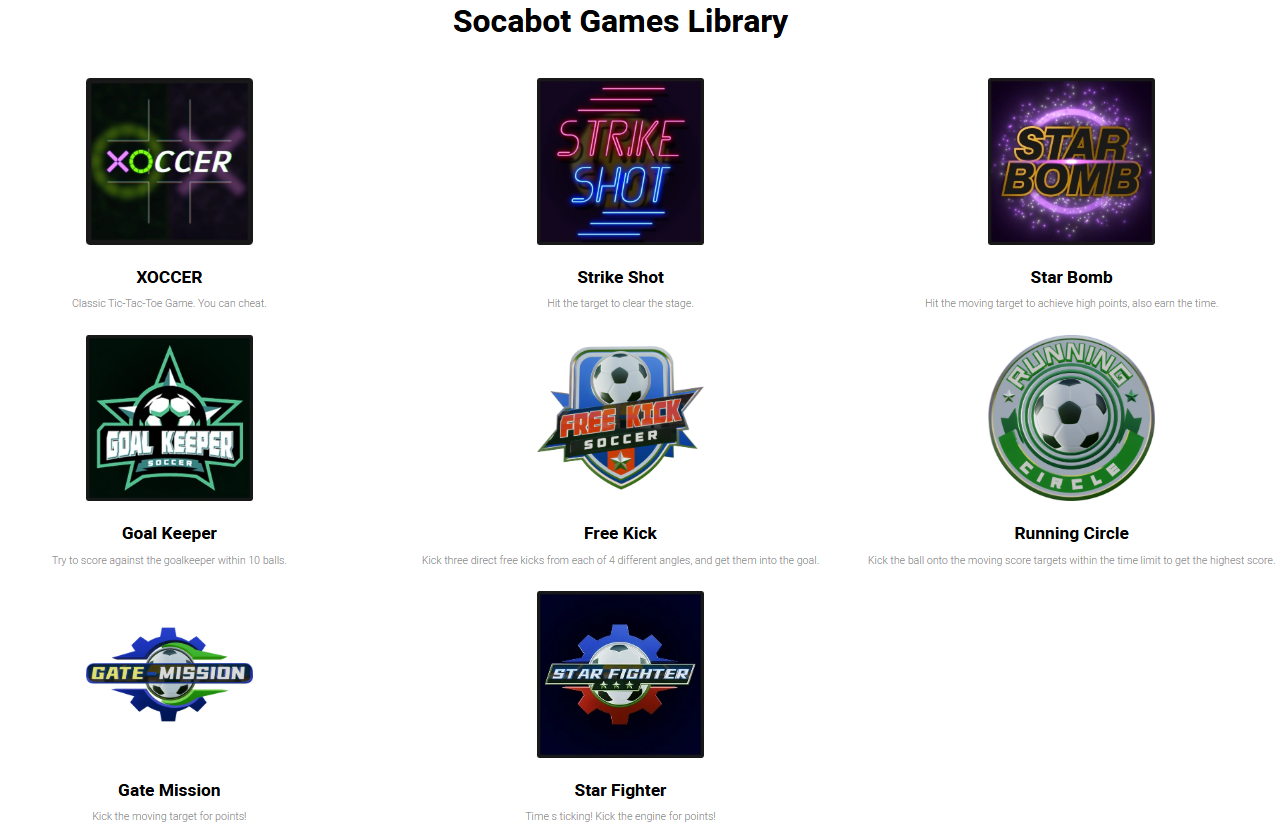
Socabot's Game Library: All 8 Modes Explained
This is exactly where Chfuntek's Socabot Interactive Soccer Simulator is built for sustained commercial engagement. The system currently offers eight distinct game modes, each designed to appeal to a different player motivation — with new games continuously in development.
A football twist on the classic grid game. Players kick at a 3×3 target wall, trying to land three hits in a row before their opponent. Naturally draws spectators and rematches.
Hit moving targets to rack up points and earn bonus time. Speed of reaction matters as much as accuracy — popular with younger players and groups competing for leaderboard position.
Players get 10 shots to score against a virtual goalkeeper with adaptive difficulty. Accessible for casual players while still challenging for those with real football experience.
Three direct free kicks from each of four different angles — twelve kicks total, navigating virtual walls and goalkeeper movement. Instantly familiar and deeply replayable for football fans.
Kick the ball onto moving score targets within a set time limit. The ticking clock and moving targets create adrenaline-driven pressure that generates social noise around the machine.
Hit moving targets as fast as possible — rewards both accuracy and pace simultaneously. Ideal for players who've mastered the slower-paced modes and want a harder challenge.
Kick designated targets to earn points, with the scoring mechanism shifting dynamically during play. Unpredictability keeps experienced players engaged session after session.
Pure score-maximization within a fixed time window. The personal-best dynamic is one of the strongest drivers of repeat visits — players return specifically to beat their previous numbers.
The Hardware Behind the Experience
Socabot's game library runs on a patented automatic ball launcher capable of delivering balls at adjustable speeds and angles, paired with the full-cycle automatic ball return system that eliminates manual ball retrieval entirely. The entire playing area fits within a 4m × 9m footprint with a minimum suspended height of 3.5m — making it realistic to install in bar corners, restaurant annexes, and FEC zones without requiring dedicated sports facility infrastructure.
Chfuntek supports international delivery via LCL, FCL, and courier, with on-site installation service available for operators who need factory engineer support at setup. The system ships in a single wooden crate at approximately 2 CBM and 350 kg — compact enough for straightforward freight handling across all markets.
Ready to See Socabot's Full Game Library?
Get a tailored quote and find out how Socabot's automation and 8 game modes would work in your specific venue.
Talk to the Chfuntek TeamFrequently Asked Questions
What does auto ball return mean in a soccer arcade game?
It means the system automatically retrieves kicked balls, transports them back to the launch position, and queues them for the next delivery — all without any staff or player involvement. A full-cycle system handles the entire process, not just part of it.
Why does auto ball return matter for commercial venues?
It eliminates manual ball retrieval, which consumes meaningful staff time during busy operating hours. It also enables faster group turnovers and consistent session pacing regardless of staff availability.
How many game modes does Socabot offer?
Socabot currently offers eight distinct game modes — Tic-Tac-Toe Challenge, Moving Target, Goalkeeper Duel, Free Kick Challenge, Time Pressure, Speed Run, Engine Kick, and High Score Attack — with new games in ongoing development.
What space does Socabot require for installation?
The entertainment version requires a minimum footprint of 4m × 9m with a suspended height of at least 3.5m, making it suitable for most commercial bar, restaurant, and FEC spaces without major structural changes.
Can Socabot handle back-to-back group sessions without staff intervention?
Yes. The patented automatic ball launcher and full-cycle ball return system are designed specifically to run continuous sessions without manual ball retrieval, allowing back-to-back group throughput during peak operating hours.
Final Thoughts
A soccer arcade game's auto ball return system and its game library aren't separate features — they work together to determine whether the machine is a profitable commercial attraction or an operational liability. The automation handles the operational side; the game variety handles the repeat visit side. Getting both right is what separates equipment that performs for years from equipment that peaks in the first month and quietly underdelivers thereafter.
Want to see Socabot's full game library and get a quote for your specific venue? Reach out to the Chfuntek team for a tailored consultation.


