
The top interactive sports simulators for entertainment centers in 2026 are golf simulators, soccer simulators, tennis simulators, baseball simulators, and badminton simulators — five categories that combine real physical play with automated technology, competitive scoring, and repeat-visit game modes. For FEC operators, sports bars, arcades, shopping malls, hotels, and resorts, these five formats currently offer the strongest combination of guest engagement, floor-space efficiency, and revenue potential per installation.
This article breaks down what makes each category work commercially and what to look for before adding one to a venue.
Why Interactive Sports Simulators Are Reshaping Entertainment Venues
Traditional arcade attractions have a ceiling on how much they can differentiate a venue, since most competing locations offer some version of the same redemption games and screen-based cabinets. Interactive sports simulators solve a different problem: they give guests something physically active to do, wrapped in the automation and scoring systems that keep a venue running efficiently during busy hours.
The five categories below share a common structural advantage — each recreates a recognizable, globally popular sport in a compact commercial footprint, without requiring the space, staffing, or weather independence a full-size outdoor version would demand.
1Golf Simulators
Golf remains one of the most consistently strong performers in commercial entertainment, largely because the format translates naturally into group bookings, corporate events, and repeat league-style play.
Runs a full 18-hole course mode with five competition formats — Stroke, Skins, Match, Foursome, and Competition — giving venues genuine variety across repeat visits rather than a single static round. Difficulty scaling from Amateur through Tour Pro means the same bay serves first-time guests and serious players, and the Magic Shot automatic ball feeder handles full-cycle ball delivery without staff intervention.
2Soccer Simulators
Football's global recognition makes it one of the easiest sports to introduce as an interactive attraction, since guests understand the basic objective without instruction.
Pairs a patented automatic ball launcher, adjustable up to roughly 110 km/h, with fully automatic ball return, so games keep moving without any staff involvement between sessions. Eight built-in game modes — including Free Kick Challenge, Goalkeeper Duel, and Time Pressure — give repeat guests genuine variety, and the compact 4m by 9m entertainment footprint fits most FEC zones, sports bar corners, and hotel lounges.
3Tennis Simulators
Tennis has historically carried real barriers to casual play — court access, proper equipment, a willing partner — that interactive simulators remove almost entirely.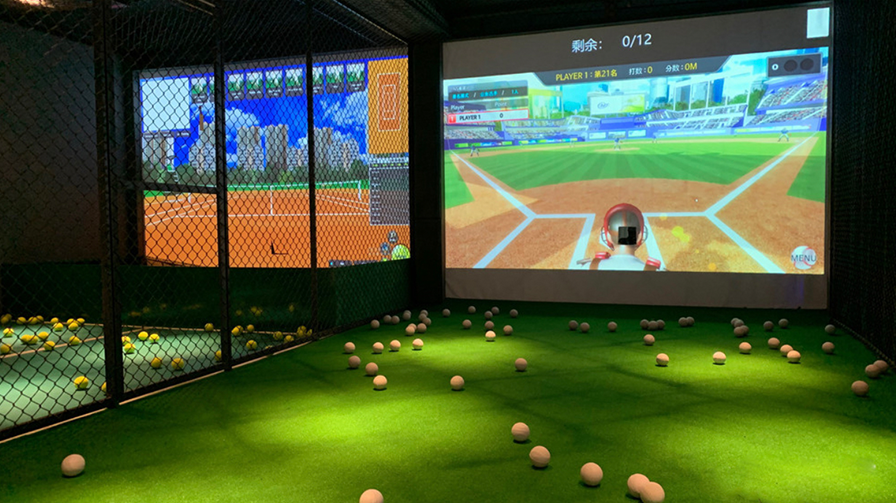
Delivers real rally-based gameplay through genuine racket-and-ball contact rather than a screen-only simulation, with fully automatic ball feeding and return keeping sessions moving continuously. Three modes — Practice, Training, and Skill Challenge — let a single installation serve casual social groups, players working on technique, and competitive guests chasing a score.
4Baseball Simulators
Baseball and softball-style batting attractions remain a strong regional draw, particularly in North American and East Asian markets where the sport carries deep cultural recognition. Modern interactive baseball simulators typically combine adjustable pitch speed and type with digital scoring and accuracy challenges, giving venues a compact alternative to a full batting cage. For entertainment centers in markets with strong baseball interest, this category consistently performs well as a complementary attraction alongside golf and soccer installations.
5Badminton Simulators
Badminton simulators are a newer but growing category, particularly popular in markets across Asia where the sport has enormous grassroots participation. These systems generally combine projected or physical shuttlecock tracking with reaction-based challenges, offering a lower-impact, family-friendly alternative to the other four categories. While the technology is less mature than golf or soccer simulation, it's an emerging option worth monitoring for venues targeting markets with strong regional badminton culture.
What These Interactive Sports Simulators Have in Common
Across all five formats, three factors consistently separate attractions that sustain long-term guest engagement from ones that get abandoned after the novelty wears off.
Automation determines daily operating cost. A simulator requiring manual ball or shuttlecock retrieval between every guest adds labor cost to every single session, while full-cycle automation lets existing floor staff cover the attraction without dedicating a person to it.
Game mode variety determines how long an attraction stays profitable. A single static format exhausts its novelty within a handful of visits for any regular guest, while multiple competition formats and difficulty levels give repeat visitors a reason to come back specifically for that attraction.
Compact, standardized footprints simplify planning. Systems designed around realistic commercial floor space — rather than requiring custom construction for every installation — make it far easier for operators to budget and plan a build-out with confidence.
Where Chfuntek Fits Across These Categories
For operators evaluating these categories across golf, soccer, and tennis specifically, Chfuntek engineers all three around the same commercial priorities: full automation, genuine multi-mode variety, and durability built for sustained daily use rather than occasional play. PLUSGOLF, Socabot, and the tennis simulator each solve the same core operational problem — keeping guests engaged and staff free — through automatic ball delivery and return systems specific to each sport.
For venues weighing which of these categories fits a specific floor plan and guest demographic, requesting a tailored recommendation before committing to a purchase is the most reliable way to match the right simulator to the right space.
Deciding Which Sports Simulator Fits Your Venue?
Get a tailored recommendation across golf, soccer, and tennis based on your floor space and guest demographic.
Talk to the Chfuntek TeamFrequently Asked Questions
Which interactive sports simulator generates the most revenue for FECs?
Golf and soccer simulators currently show the strongest combined performance across direct session fees, group bookings, and repeat visits, though results vary by local market demand and how actively a venue markets group events.
Do interactive sports simulators require dedicated staff to operate?
Well-designed systems with full-cycle automatic ball delivery and return require minimal staff involvement, allowing existing floor staff to oversee multiple attractions rather than dedicating a person to each one.
Are badminton and baseball simulators as established as golf or soccer simulators?
Not yet. Golf and soccer simulator technology is more mature and widely deployed commercially, while baseball and badminton simulators are earlier-stage or more regionally concentrated categories worth evaluating based on local market interest.
Can one simulator serve both casual guests and serious players?
Yes, provided the system offers adjustable difficulty and multiple game modes. Systems like PLUSGOLF, Socabot, and Chfuntek's tennis simulator are specifically designed to scale from beginner-friendly play to competitive challenge on the same installation.
What space do interactive sports simulators typically require?
Requirements vary by sport and configuration, but compact entertainment-format systems like Socabot (4m by 9m) are designed to fit standard FEC, sports bar, and hotel floor plans without custom construction.
How do I decide which simulator category fits my venue?
Start with your guest demographic and available floor space, then request configuration guidance from the manufacturer to confirm which sport and format genuinely fits your specific business model rather than choosing based on trend alone.
Final Thoughts
Interactive sports simulators have become a core part of the modern entertainment center attraction mix because they combine recognizable sports, genuine physical play, and the automation commercial venues need to operate efficiently. Golf, soccer, and tennis currently lead the category in terms of proven commercial performance and mature technology, with baseball and badminton simulators representing strong complementary or regionally specific additions depending on a venue's target market.
Deciding which simulator category fits your venue? Contact the Chfuntek team for a tailored recommendation.


