
This guide covers what an interactive tennis simulator is, which features matter for commercial operation, what installation and ongoing costs look like, and the commercial benefits that make it a viable revenue addition for different venue types.
What Is an Interactive Tennis Simulator and How Does It Work?
An interactive tennis simulator combines the physical mechanics of real tennis — a genuine racket, real balls, and natural swing motion — with a digital gameplay environment projected onto a large screen or display surface.
Sensors track ball impact and player movement, translating physical shots into on-screen responses in real time. The result is a tennis experience that requires no outdoor court, no court booking, and no opposing player while still delivering the physical engagement and competitive dynamics that make tennis socially compelling.
The format serves a broader audience than traditional tennis because it removes two common barriers to casual participation: needing a second player of similar ability and needing access to a court.
A first-time player can pick up a racket and complete a rally or accuracy challenge in minutes. An experienced player can engage with difficulty settings and competitive modes that test their tennis skills. Both can use the same installation during the same operating day.
Key Features of a Commercial Interactive Tennis Simulator
Real Rackets and Balls — Not Controllers
This is one of the design decisions that separates commercial interactive tennis simulators from VR or controller-based alternatives.
Using genuine rackets and tennis balls means the physical experience feels connected to the sport. This matters for tennis players, but it also gives casual guests a physical activity rather than another screen-based game.
The visibility of someone swinging a real racket at a large screen can also help attract attention from other guests in an entertainment venue.
Automatic Ball Feeding and Return
For commercial viability, automation is an important feature. A system that requires staff to feed balls between shots or retrieve them manually after every session can create additional labor requirements and reduce throughput.
Commercial interactive tennis simulators can use automatic ball feeding and ball return to keep the system ready for the next player or group with less manual intervention.
Game Modes for Different Player Types
A commercially durable interactive tennis simulator needs enough gameplay variety to hold the attention of returning guests.
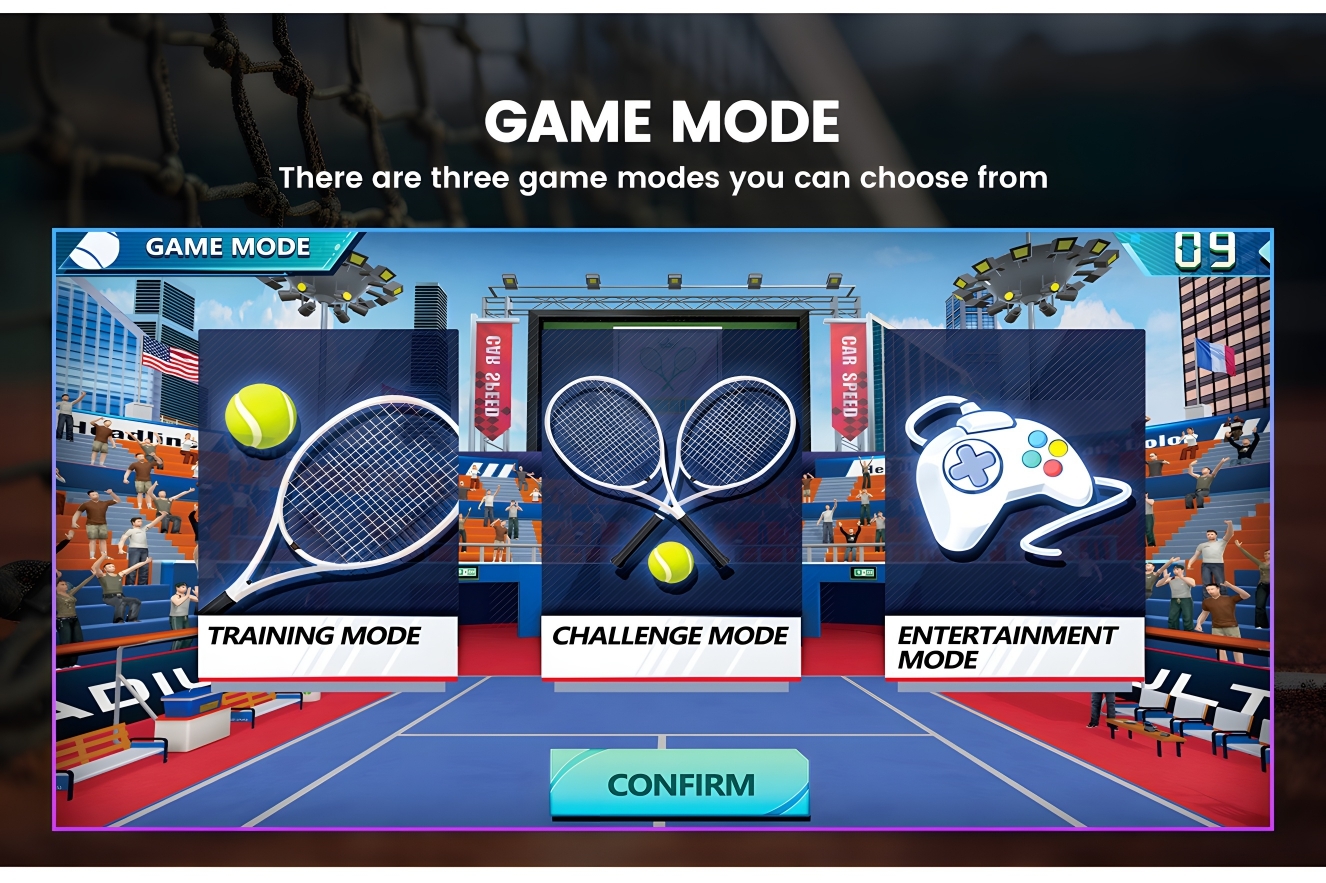
A practical commercial configuration should provide different experience types, including casual gameplay for first-time players, structured training for skill-focused users, and competitive scored challenges for guests who want measurable results.
Multiple modes can also help operators create different pricing packages and event formats.
Adjustable Difficulty
An attraction designed only for experienced tennis players leaves a large portion of a commercial venue's customer base underserved.
Adjustable difficulty can make the same installation more accessible to children, casual adults, beginners, and experienced players without requiring a different machine for each customer group.
Durability and Cycle Capacity
Commercial venue equipment is used differently from home or light-use systems. A simulator operating for many hours per day across repeated guest sessions needs construction and components appropriate for that usage profile.
Operators should evaluate screen durability, mechanical components, electrical systems, software stability, and expected operating cycles before purchasing.
Interactive Tennis Simulator Cost: What to Budget
The cost of a commercial interactive tennis simulator varies according to configuration, installation complexity, automation, software, and supplier requirements. For initial planning, operators can use the following broad budget ranges.
| Configuration | Estimated Budget | Typical Application |
|---|---|---|
| Entry-Level Commercial Setup | $12,000–$20,000 | Smaller venues, hotels, or supplemental entertainment attractions. |
| Mid-Range Commercial System | $20,000–$45,000 | FECs, sports bars, hotels, entertainment zones, and tennis centers. |
| Premium / Multi-Bay Installation | $45,000–$80,000+ | Large FECs, shopping malls, tennis centers, and multi-attraction venues. |
These figures should be treated as planning ranges rather than fixed quotations. The final project cost depends on equipment configuration, screen or projection requirements, installation, freight, software, customization, and local site conditions.
Operators should also consider ongoing maintenance, software support, replacement balls, mechanical servicing, and other consumables when calculating the total cost of ownership.
Commercial Benefits of an Interactive Tennis Simulator
FECs and Arcade Entertainment Centers
An interactive tennis simulator gives FEC operators a sports-based physical attraction that can serve children, families, recreational players, and competitive adults from a single installation.
Session-based pricing, party package add-ons, tournaments, and special events can all be integrated into an FEC business model.
Sports Bars and Pubs
Tennis is already a strong spectator sport during major tournaments. An interactive tennis simulator turns that interest into an active participation experience.
Sports bars can use tennis challenges during major events, quieter evenings, group activities, or promotional campaigns. Competitive scoring can also create an additional social element for groups.
Hotels and Resorts
Year-round indoor play is a major advantage for hotels and resorts. Guests can use an interactive tennis simulator regardless of outdoor weather or traditional court availability.
It can be particularly useful for family-oriented properties and resorts looking to add more activities without constructing a complete tennis court.
Tennis Centers and Sports Centers
For tennis clubs and sports centers, an interactive tennis simulator can complement traditional court facilities.
It can provide an alternative activity when courts are occupied, introduce beginners to tennis, support junior activities, or create additional entertainment and training programs.
Shopping Malls
The visual impact of a player using a real racket in front of a large digital screen can make an interactive tennis simulator highly visible in a shopping mall environment.
Passing shoppers can see the activity from outside the attraction, creating opportunities for spontaneous participation and additional foot traffic.
Chfuntek Commercial Interactive Tennis Simulator
Chfuntek develops commercial sports entertainment equipment for venues looking to add interactive attractions to their spaces.
The Chfuntek interactive tennis simulator combines real rackets and balls with sensor and projection technology to create an indoor tennis experience designed for commercial applications.
Automatic ball feeding and return can reduce the need for manual ball handling between sessions, helping operators maintain a smoother customer flow during busy periods.
The system can support different gameplay experiences, including practice-oriented activities, structured training, and skill-based challenges. This allows operators to serve different customer groups using the same installation.
For commercial projects, Chfuntek can also provide installation guidance and operator training to help venues integrate the system into their floor plans and operating models.
If you are evaluating an interactive tennis simulator for an FEC, sports bar, hotel, tennis center, or other entertainment venue, the most practical approach is to discuss your available space, target customers, and expected operating model with the supplier before selecting the final configuration.
How to Choose the Right Interactive Tennis Simulator
Choosing an interactive tennis simulator should involve more than comparing equipment prices. Commercial buyers should evaluate the complete system and its long-term operating requirements.
- Commercial durability: Confirm that the system is designed for repeated daily use.
- Automation: Check whether ball feeding and return can operate automatically.
- Game variety: Look for enough modes to serve beginners, families, and experienced players.
- Difficulty adjustment: Make sure different customer groups can use the same system.
- Space requirements: Confirm exact dimensions, ceiling height, hitting distance, and safety clearance.
- Installation: Ask whether professional installation or technical guidance is available.
- After-sales support: Check warranty, spare parts availability, software support, and technical assistance.
- Customization: For commercial venues, consider whether branding, gameplay, or configuration can be adapted to the project.
How Much Space Does an Interactive Tennis Simulator Need?
Space requirements vary depending on the simulator design and configuration. Commercial operators generally need enough room for the player's full racket swing, safe player movement, ball travel, screen clearance, and equipment installation.
Some commercial configurations may require a ceiling height of approximately 12 to 14 feet (3.7 to 4.3 meters) and sufficient depth between the hitting position and screen.
However, these numbers should not be treated as universal requirements. Exact dimensions vary between systems, so the supplier should confirm the required floor area and ceiling height before the venue finalizes its floor plan.
Is an Interactive Tennis Simulator a Good Investment?
An interactive tennis simulator can be a viable investment when the attraction matches the venue's customer profile, available space, pricing strategy, and expected traffic.
The strongest commercial advantage is that the equipment can generate revenue from relatively compact indoor space while providing a physical and social experience.
Possible revenue models include:
- Pay-per-play sessions
- Timed gameplay packages
- Group bookings
- Birthday and private events
- Corporate team-building activities
- Tennis training packages
- Tournaments and leaderboard competitions
- Membership or loyalty programs
The actual return on investment depends heavily on local pricing, venue traffic, utilization, staffing, rent, maintenance, and marketing. Operators should calculate expected revenue using their own local operating data rather than relying on a universal ROI figure.
Frequently Asked Questions
An interactive tennis simulator is a commercial attraction that uses real rackets and balls, sensor technology, and projection or screen-based gameplay to create a tennis experience indoors without a full-size court. Players physically swing and strike real balls while the system tracks gameplay and provides digital responses.
Complete commercial installations can range from approximately $12,000 to $80,000 or more depending on configuration, automation level, game content, installation complexity, and project requirements. The actual quotation should be based on the specific venue and system configuration.
A commercial system should ideally provide different experiences for different users, including casual gameplay, structured training, and competitive skill challenges. Multiple modes can help improve repeat-play potential.
A fully automated system can reduce staff involvement. Automatic ball feeding and return allow the attraction to cycle between groups with less manual handling, which can be particularly useful for venues operating with lean staffing.
Requirements vary by system. Operators need sufficient ceiling height, hitting depth, screen clearance, and width for a full racket swing. Exact dimensions should always be confirmed with the supplier before finalizing the venue floor plan.
It can be a viable commercial attraction when equipment, pricing, venue traffic, utilization, and operating costs are properly matched. Operators should calculate potential revenue based on their specific market and expected utilization rather than relying on a fixed profitability estimate.
Final Thoughts
An interactive tennis simulator can be a strong commercial investment for indoor sports and entertainment venues in 2026. It provides a physical, social, and technology-driven tennis experience while requiring significantly less infrastructure than building a traditional full-size court.
The features that matter most commercially are the ones that directly affect daily operation: automatic ball handling, game mode variety, adjustable difficulty, commercial-grade durability, and reliable after-sales support.
For operators evaluating different systems, the best starting point is a complete project assessment that considers equipment, installation, floor space, software, support, and operating costs rather than comparing hardware prices alone.
Planning an Interactive Tennis Simulator Project?
Explore how Chfuntek's commercial interactive tennis simulator can fit your venue, floor plan, and entertainment concept.
Contact Chfuntek

