
If you want to practice tennis at home, a tennis simulator for home can provide a practical way to train indoors when you do not have regular access to a tennis court. By combining real tennis equipment, ball-return technology, interactive targets, and digital training or game environments, a home tennis simulator can help you work on timing, accuracy, reactions, and consistency in a controlled space.
The key is to choose the right setup for your available space and training goals. A simulator does not replace every aspect of playing on a real court, but it can make tennis practice more convenient and easier to fit into a daily routine.
Why Use a Tennis Simulator for Home Practice?
Finding time for regular tennis practice can be difficult. Weather, court availability, travel time, and membership costs can all make traditional practice less convenient.
A tennis simulator for home brings part of the tennis experience indoors. Instead of traveling to a court every time you want to practice, you can use an indoor setup for shorter and more frequent sessions.
This is particularly useful for players who want to focus on repetition. Tennis improvement often requires repeated practice rather than occasional long sessions. Having an indoor training environment can make it easier to build a consistent routine.
A home tennis simulator can be useful for:
- Practicing tennis indoors regardless of weather
- Improving shot accuracy and timing
- Working on reaction and coordination
- Repeating specific challenges
- Adding variety to regular tennis training
- Practicing in a private environment
- Combining training with interactive tennis games
For families, an interactive system can also make practice more enjoyable for children and beginners who may not be ready for long sessions on a traditional court.
How to Practice Tennis at Home With a Tennis Simulator
The most effective approach is to treat the simulator as a structured training tool rather than simply an entertainment screen. Start with a specific objective for each session and gradually increase the difficulty.
1. Start With Short, Focused Sessions
You do not need to practice for hours. A 20–30 minute session can be useful when it has a clear purpose.
For example, one session could focus on accuracy while another concentrates on reaction speed. Short sessions also make it easier to practice regularly.
A simple weekly routine could include:
- Accuracy practice
- Reaction and timing drills
- Forehand and backhand practice
- Target challenges
- Competitive game modes
- Free practice
The exact routine should depend on the player's skill level and the capabilities of the simulator.
2. Focus on Accuracy Before Speed
When practicing tennis at home, it can be tempting to hit every ball as hard as possible. However, consistent placement is often more useful than simply increasing power.
Use interactive targets or designated hitting areas to practice controlling where the ball goes. Once accuracy becomes more consistent, gradually increase the pace or difficulty.
This approach can make a home tennis training setup more useful for both beginners and experienced players.
3. Use Interactive Challenges to Make Practice More Engaging
One advantage of an interactive tennis simulator is that practice does not have to feel repetitive.
Digital targets, scoring systems, timed challenges, and game-style exercises can turn individual shots into measurable objectives. Instead of simply hitting a ball, players have a reason to aim, react, and improve their score.
This is especially useful for younger players. A traditional training drill may feel repetitive, while an interactive challenge can make the same type of movement more engaging.
4. Gradually Increase the Difficulty
Good tennis practice should challenge the player without making the activity frustrating.
Start with simple targets and slower or more predictable challenges. As accuracy and reaction ability improve, increase the difficulty.
A progressive approach can look like this:
Beginner: Focus on basic coordination, timing, and consistent contact.
Intermediate: Add more demanding targets, faster reactions, and longer practice sequences.
Advanced: Use challenging game modes that require faster decisions, accuracy, and consistency.
The purpose is not to make every session difficult. The goal is to create measurable progress.
What Do You Need for a Tennis Simulator for Home?
A successful tennis simulator for home requires more than the simulator itself. The available room, ceiling height, player movement area, hitting distance, screen or projection system, and ball-return configuration all need to be considered.
Before purchasing equipment, measure the room carefully.
Important factors include:
Available Floor Space
The room needs enough depth for the player to stand comfortably and swing the racket without restrictions. Additional space may also be required for the ball-return system and equipment.
Ceiling Height
Ceiling height is particularly important because tennis involves an overhead swing. A room that feels large enough for normal movement may still be unsuitable if the ceiling is too low.
Player Safety
There should be sufficient clearance around the player and equipment. The hitting area should be planned so that players can move naturally without coming into contact with walls, lighting, furniture, or other objects.
Installation Requirements
Depending on the system, installation may involve a projection screen, display system, ball-return mechanism, tracking technology, and supporting structure.
For this reason, it is better to plan the complete installation before ordering equipment rather than trying to fit a simulator into an unsuitable room afterward.
Tennis Simulator for Home vs Traditional Tennis Practice
A tennis simulator for home and a traditional tennis court serve different purposes. The simulator is best viewed as a complementary training and entertainment solution rather than a complete replacement for outdoor or indoor court play.
| Tennis Simulator for Home | Traditional Tennis Court |
|---|---|
| Convenient indoor access | Full-size playing environment |
| Practice regardless of weather | Real court conditions |
| Interactive targets and challenges | Natural opponent interaction |
| Suitable for short practice sessions | Better for complete match practice |
| Can provide immediate scoring | Real competitive match experience |
| Useful for repetition and coordination | Essential for full-court movement |
A simulator can therefore be particularly valuable between court sessions. Players can work on repetition, reactions, accuracy, and coordination at home and then apply those skills during real matches.
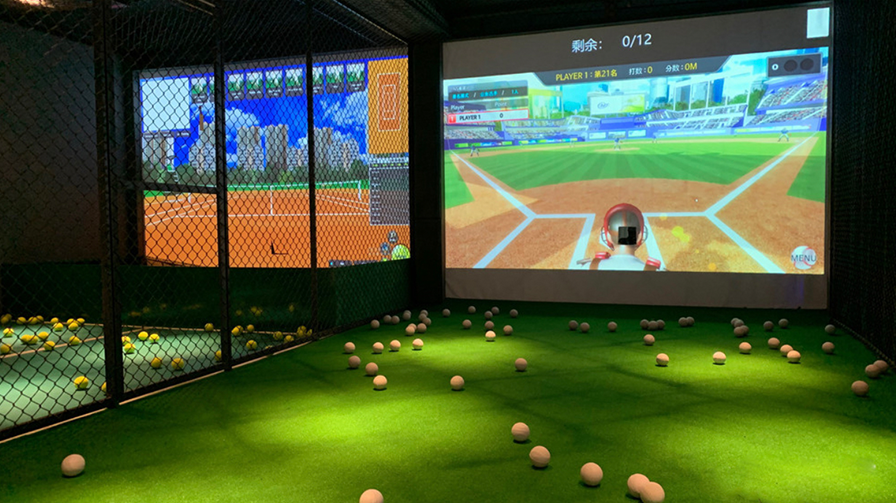
How Chfuntek Approaches Interactive Tennis
Chfuntek Interactive Tennis Simulator
For customers considering a tennis simulator for home, Chfuntek focuses on combining real physical tennis activity with interactive digital gameplay.
Chfuntek's interactive tennis simulator is designed around a simple concept: players use a real racket and ball while interacting with a projected or digital game environment. The system can provide an engaging combination of tennis practice, skill challenges, and entertainment.
This type of setup can be considered for private homes, clubs, sports facilities, hotels, resorts, and other indoor entertainment environments.
For home users, the most important consideration is whether the system can be properly integrated into the available room. Chfuntek can also discuss space planning and equipment configuration according to individual project requirements.
The goal is not simply to put a large screen in a room. A useful interactive tennis setup needs to consider player position, ball movement, screen placement, equipment layout, and safe movement space together.
Can a Tennis Simulator Help You Practice Every Day?
One of the biggest advantages of a tennis simulator for home is convenience.
When practice requires driving to a tennis club, booking a court, or waiting for suitable weather, players may practice less frequently. An indoor setup can remove some of these barriers.
For example, a player might spend 20 minutes practicing after work rather than waiting for a free court on the weekend.
Frequent short sessions can be particularly useful for developing consistency. However, players should combine simulator practice with real-court training when possible, especially for full-court movement, serving, rallying with an opponent, and match strategy.
The simulator is most valuable when it complements rather than replaces broader tennis development.
How to Choose a Tennis Simulator for Home
Before choosing equipment, consider your primary reason for installing it.
If your priority is training, look for a system that supports meaningful repetition, interactive challenges, and adjustable difficulty.
If entertainment is more important, consider game variety, visual interaction, scoring, and multiplayer options.
If the system will be used by a family, flexibility becomes more important. Children, beginners, and experienced players should all be able to participate without the experience becoming too difficult for less experienced users.
You should also ask the supplier about:
- Required room dimensions
- Recommended ceiling height
- Installation process
- Ball-return system
- Software and game options
- Training functions
- Customization possibilities
- Maintenance requirements
- Warranty and technical support
These questions can help prevent a common mistake: choosing equipment first and discovering later that the room cannot accommodate the complete system.
Is a Tennis Simulator for Home Worth It?
Whether a tennis simulator for home is worth the investment depends on how frequently it will be used, the available space, and the user's goals.
For someone who plays tennis regularly and wants convenient indoor practice, the value can come from accessibility and repetition. A family may also benefit from having an activity that combines sports, entertainment, and interactive gameplay.
However, a simulator should not be evaluated only by comparing its price with the cost of tennis court rental. Consider how often the system will actually be used and whether it supports the type of practice you want.
For homeowners with enough space, sports enthusiasts, private clubs, and premium residential facilities, an interactive tennis simulator can become a long-term indoor sports and entertainment feature.
Frequently Asked Questions
Can I really practice tennis at home?
Yes. With the right indoor setup, you can practice tennis-related skills such as timing, accuracy, coordination, reaction, and consistency at home. A tennis simulator can make this practice more interactive and structured.
What is the main benefit of a tennis simulator for home?
The main benefit is convenience. You can practice indoors without traveling to a tennis court, while interactive challenges can make repeated practice more engaging.
Does a home tennis simulator replace a real tennis court?
No. It can complement traditional tennis practice but does not completely replace full-court movement, match play, serving situations, or playing against a real opponent.
How much space is needed for a tennis simulator for home?
Space requirements depend on the specific equipment and configuration. You should consider the complete player movement area, hitting distance, ceiling height, screen, ball-return system, and safety clearance rather than looking only at the equipment footprint.
Is a tennis simulator suitable for beginners?
Yes. Interactive challenges can be adjusted to different ability levels depending on the system. Beginners can focus on basic coordination and accuracy before progressing to more challenging activities.
Final Thoughts
The easiest way to practice tennis at home is to create a setup that makes regular practice convenient, focused, and enjoyable. A tennis simulator for home can support this by combining real tennis activity with interactive targets, digital challenges, scoring, and indoor convenience.
It is not a complete substitute for a real tennis court, but it can fill an important gap between court sessions. For players who want to practice more frequently, families looking for an indoor sports activity, or private facilities seeking a premium entertainment feature, an interactive tennis simulator can be a practical option.
Chfuntek provides interactive sports entertainment solutions designed for different venue and project requirements. If you are considering an interactive tennis simulator for your home, private club, hotel, resort, or sports facility, Chfuntek can help you evaluate the available space and determine a suitable equipment configuration.
The right setup starts with the room, the intended use, and the type of tennis experience you want to create.
Explore Chfuntek Tennis Simulator Solutions
Looking for a tennis simulator for home or another indoor sports project? Contact Chfuntek to discuss your available space, intended use, equipment configuration, and customization requirements.


